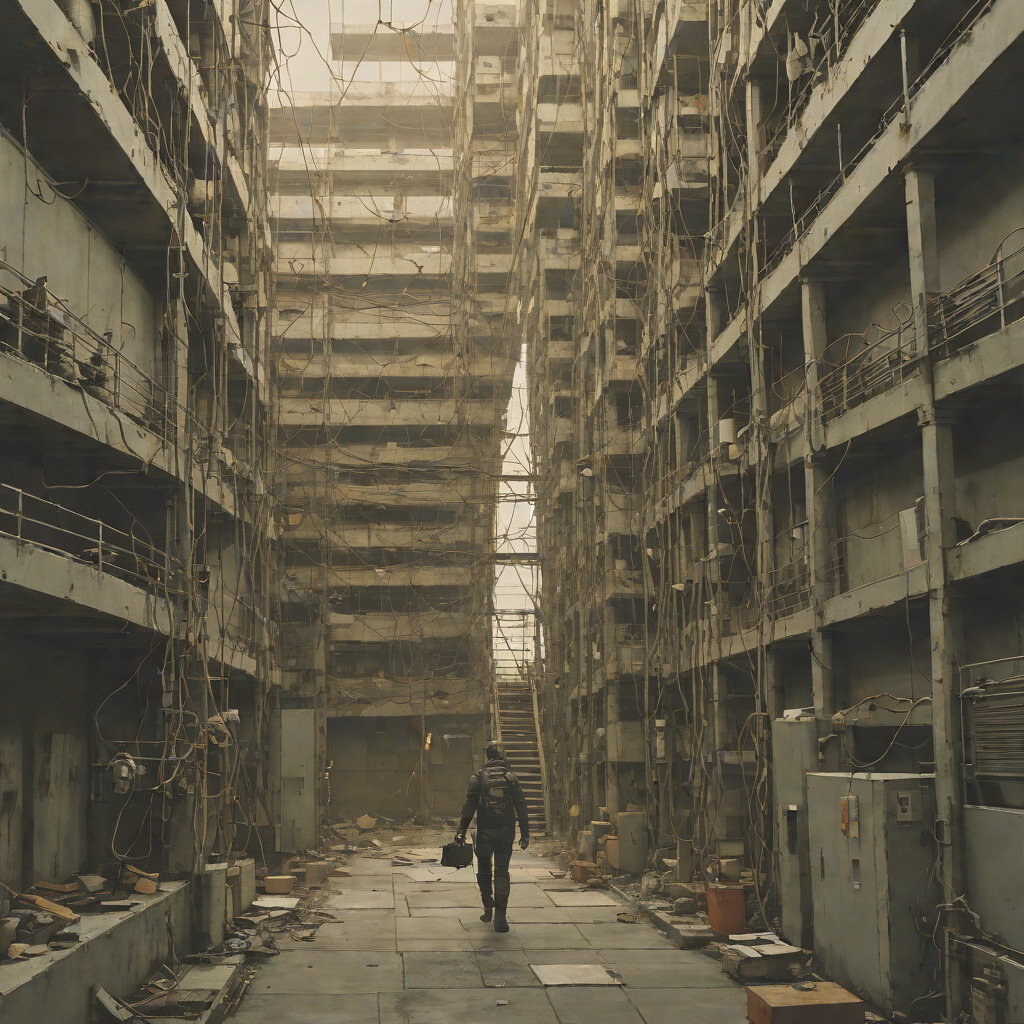
Elton Parrakis’s death
The Running ManElton Parrakis’s death is the decisive end of the pursuit that briefly binds him to Ben Richards. After a police cruiser wounds Richards and overturns, Parrakis escapes in the damaged air car, but Richards seizes control and forces the injured officer to carry him away. Parrakis’s death is therefore neither a simple execution nor a clean victory: it is a grotesque, reluctant exchange in which the hunter becomes the fugitive’s driver, the damaged vehicle becomes both shelter and burden, and Richards’s escape depends on the dying man’s last exertion.
Causes and Background
Parrakis enters the episode as the driver of the pursuing cruiser, one more instrument of the state’s hunt for Richards. The chase has already reduced the city to stark mechanical images: headlights turn the road into a “sunless day,” the cruiser fights for traction, and the Sten gun converts pursuit into bodily damage. A bullet passes through Richards’s left arm, but the reversal comes when Richards fires back and shatters the driver’s window. The cruiser rolls over its roof and side, leaving the police radio crackling in the sudden silence.
The immediate cause of Parrakis’s death is the crash and the violence of the chase, but the scene places responsibility within a larger system. Parrakis is not acting in a private quarrel; he is pursuing a contestant whom the television network has already represented as a public monster. Bobby Thompson’s broadcast presents Richards as a wolf who walks among ordinary people, promises New Dollars for sightings and kills, and turns police deaths into proof of Richards’s supposed criminal nature. The broadcast’s portrait is visibly manufactured: Richards’s face is retouched into an urban bogeyman, while Sheila Richards is airbrushed into a grotesque caricature. Parrakis’s death thus occurs inside a spectacle that makes killing appear like entertainment and reduces both pursuer and pursued to roles.
What Happens
After the cruiser overturns, Richards crawls toward it despite his broken ankle. Parrakis has climbed into the air car and tries to restart it, but his panic makes him forget to open the safety vents. Each turn of the key produces only a hollow cough from the air chambers. When Parrakis finally pulls the vent lever and starts the engine, he drives toward Richards, who reaches the passenger door and throws himself inside. The escape is immediately unstable: Parrakis banks onto Route 77, the car’s lower deck nearly scraping the paving, while distant sirens begin converging on them.
Richards soon takes the wheel. He knocks Parrakis’s hand from the throttle and turns the air car sharply into an alley, where its blunt nose crashes through trash, garbage cans, splintered crates, and brick. The impact throws Richards into the dashboard and breaks his nose. Parrakis is left slumped over the steering wheel, a silent, bleeding mass. Richards reloads the gun with shells Bradley Throckmorton supplied, but the approaching cruiser forces him to abandon the exposed position and crawl beneath the damaged vehicle.
The car can run on only five of its six cylinders and will not exceed forty, leaning drunkenly to one side. Parrakis’s injury is catastrophic: the steering column has entered his abdomen, and blood covers the dented wheel and Richards’s hands. Nevertheless, Parrakis directs Richards through the back roads. He asks to be placed in the driver’s seat, insisting that he can “play hare”—driving for as long as he can so that the police will follow him rather than Richards. Richards initially refuses because Parrakis is visibly incapable of driving, but Parrakis responds with a desperate demand to be allowed to contribute before death overtakes him.
Richards then performs the practical labor of the scene’s final reversal. He pushes Parrakis into position behind the wheel, his hands slipping through the man’s blood; the front seat becomes an abattoir. Parrakis continues to bleed as the air car rises, turns, and bumps against trees before finding the road. Richards expects to hear the crash, but no crash comes. Instead, the failing cylinders grow faint until the car disappears into the deadly one-cylinder-flat rhythm that will eventually burn out the remaining machinery. Parrakis is left alone with the vehicle, and his fate is understood through that fading mechanical sound rather than through a witnessed final breath.
Consequences and Aftermath
Parrakis’s death leaves Richards stranded without the vehicle, the crutches he had bought for his disguise, or the protection of a moving machine. The escape has saved him from the immediate cruiser pursuit, but it has also cost him mobility. His ankle is broken, his arm is wounded, and his nose is ruptured; the injury to his side later opens into a deep, ugly canal that has bled heavily. The damaged air car therefore functions as a temporary extension of Parrakis’s dying body: it carries Richards away, but its failing cylinders announce that the reprieve cannot last.
The event also complicates the moral structure imposed by the televised hunt. The Games’ propaganda calls Richards a killer and frames police officers as fresh, vulnerable heroes, while suppressing the violence and manipulation that produce the chase. Yet the death scene does not allow Richards to remain a purely triumphant fugitive. He shoots at the cruiser, commandeers Parrakis’s vehicle, forces a mortally wounded man to move, and finally helps that same man reach the driver’s seat. Survival requires coercion, but it also requires physical assistance. The relationship changes repeatedly within minutes: adversaries become captor and captive, captive becomes driver, and driver becomes a dying accomplice whose last action extends Richards’s life.
Parrakis’s death is followed not by safety but by continued exposure. Richards is soon forced to hide in a car while tanks and armed forces surround the area, and his consciousness begins to fracture under exhaustion, blood loss, and fear. He floats in and out of awareness, contemplates an official “accident” narrative that would bury the truth, and becomes increasingly concerned about Amelia Williams, who has been caught in the same machinery of pursuit. The death therefore marks a transition from one chase to a wider crisis rather than a resolution.
Narrative Function and Significance
The scene’s structure is built on repeated reversals. The police cruiser first appears to possess total control; Richards’s return fire destroys it. Parrakis seems to be the defeated enemy; he then restarts the air car and carries Richards away. Richards appears to have escaped; the crash leaves both men trapped in a failing machine. Finally, Parrakis appears useless because of his wounds, yet his decision to drive gives Richards the only usable route forward. Each reversal shifts the value at stake from domination to survival, and survival remains provisional at every stage.
The prose makes bodily injury and machinery mirror one another. Parrakis’s abdomen is pierced like the vehicle’s damaged structure; blood warms the steering wheel while the cylinders cough, stall, and restart. The car’s lopsided movement resembles the men’s altered relation to one another: neither is in control for long, and every attempt at control produces another loss. Even the final evidence of death is mechanical rather than ceremonial. The fading thumpa-thumpa-thumpa of the air cylinders stands in for a human departure, joining the dying man to the broken technology that has carried him into his last act.
This is also a scene of traumatic perception. Richards’s consciousness has already been disturbed by nightmares, including a dream in which he exists only as an invisible watcher in a dim underground room. Later, while injured and hiding, his mind turns toward fragmented images and distant voices, and the approach of danger becomes a hallucination-like field of servomechanisms, infrared eyes, and radar scopes. Parrakis’s death belongs to that same movement from ordinary chronology into dislocated sensation: pursuit, crash, blood, and fading sound are rendered as an experience in which the body remains active after coherent judgment has begun to fail.
Most importantly, the death exposes the gap between the official story and the lived event. The Network claims that deaths connected with the hunt are accidents and denies responsibility for the murder of Sheila Richards and Cathy Richards, while its broadcasts arrange images and accusations to make Richards appear to be the sole source of violence. Parrakis’s end cannot be absorbed so easily into that frame. It is produced by the chase, shaped by propaganda, and completed through an improvised cooperation between two men whom the system defines as enemies. The event consequently reveals the instability of the categories of contestant, murderer, hero, and victim: the broadcast demands a simple narrative, while the scene itself records a chain of pressure, injury, fear, coercion, assistance, and loss.